Four-day intensive · Open to all
Tango - Foundation 1
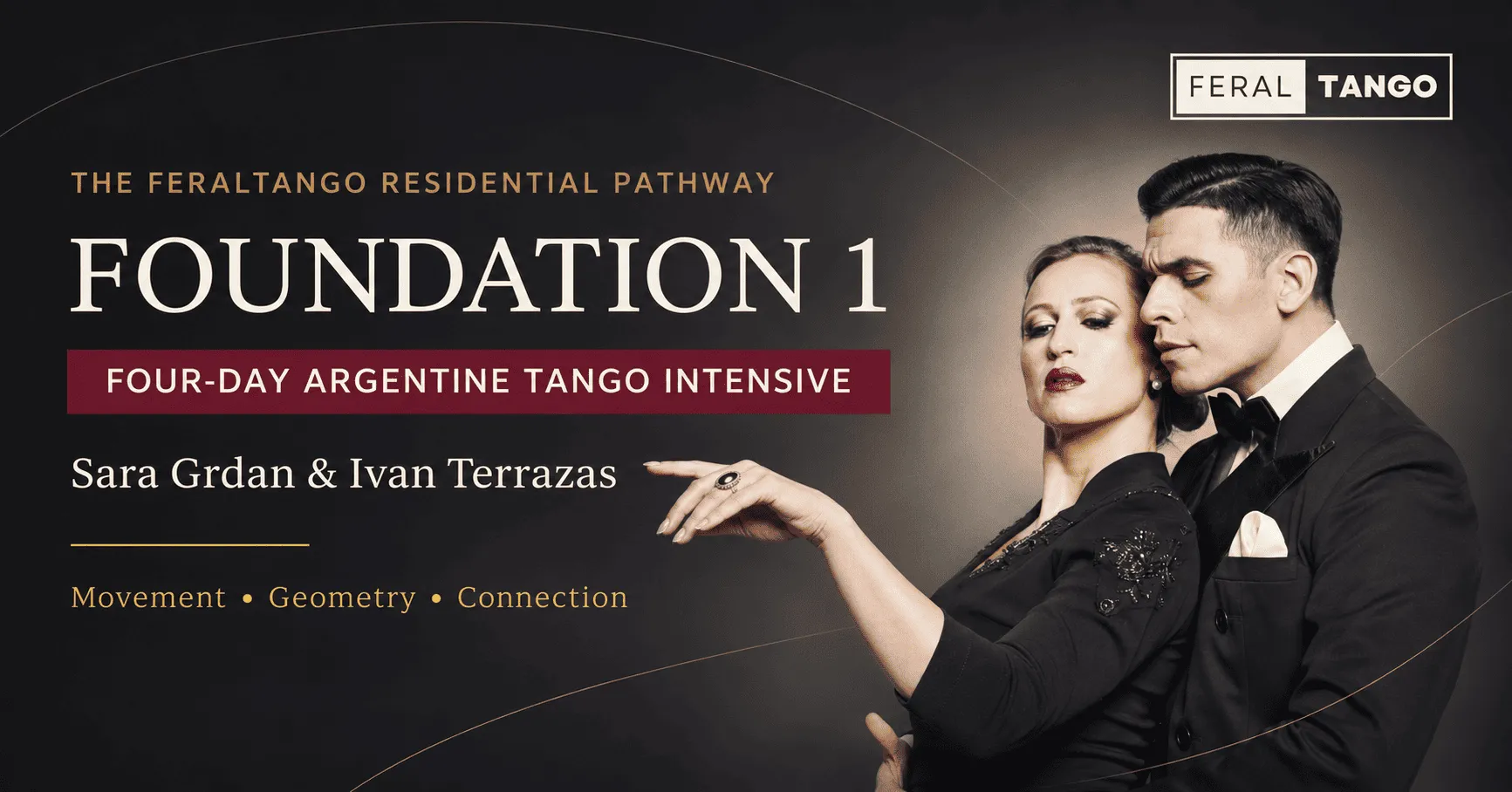
THE FERALTANGO RESIDENTIAL PATHWAY
FOUNDATION 1
CURRICULUM INFORMATION FOUR-DAY ARGENTINE TANGO INTENSIVE
Foundation 1 gives dancers a coherent way to understand how tango movement is created. Across four days, participants connect individual mechanics to partner geometry, then use those principles to develop clearer direction, more adaptable movement and more reliable communication.
DAY 1 Body Mechanics:
Axis and Articulation We begin with the organization of the individual body. Participants examine how axis, articulation, weight transfer and functional tone produce clear forward, backward and lateral movement.
TECHNICAL FOCUS
- Organizing the axis
- Articulation and weight transfer
- Walking mechanics
- Functional tone versus unnecessary tension
- Forward, backward and lateral movement
APPLIED INTEGRATION
- Generating movement through the axis
- Coordinating the standing and moving body
- Maintaining alignment and stability
- Remaining responsive without losing organization.
DAY 2 Cross and Parallel Systems
Day 2 places individual mechanics inside the geometry of the couple. Participants examine how cross and parallel systems change pathway, position, alignment, spacing and the movement available to each partner.
TECHNICAL FOCUS
- Parallel-system organization and walking in front
- Outside-partner positions in the parallel system
- Cross-system organization
- Introduction to spiral and rotational organization
- Directional pathways and alignment
- Relative position and partner spacing
APPLIED INTEGRATION
- Maintaining individual organization within the couple
- Preserving walking mechanics as partner geometry changes
- Creating space from the ground up
DAY 3 Tree of Tango
Building Simple to Complex Geometries Tango geometry is developed progressively, beginning with linear pathways and expanding through spiral organization, circular pathways and simple turns. Complexity is built by adding biomechanical and geometric layers to principles already established.
TECHNICAL FOCUS
- Linear pathways and navigation
- Curving linear movement Paradas, barridas and sacadas
- Simple turn structures
- Circular pathways
- Leader and follower spatial organization
- Maintaining axis through changing geometry
- Adapting turn structures
APPLIED INTEGRATION
- Building complexity in progressive layers
- Connecting biomechanics, geometry and communication
- Maintaining stability as geometry changes
DAY 4 Connection, Communication and Direction
The final day examines how organized movement becomes shared movement. Participants connect energy, timing, tone and direction to understand communication as a physical exchange rather than a predetermined choreography.
TECHNICAL FOCUS
- Communication versus choreography
- Establishing and maintaining connection
- Communicating direction through shared pathways
- Generating and modulating energy
- Timing and synchronization
- Matching tone without creating unnecessary tension
- Maintaining connection through instability and transition
- Communication in curved and rotated movement
APPLIED INTEGRATION
- Creating internal coherence
- Applying universal principles through personal style
- Understanding movement through WHAT, HOW and WHY
- Applying the same communication principles across linear, curved and rotated systems
Curriculum progression
Foundation 1 progresses from organizing the individual body to understanding the geometry of the couple. Participants then use those foundations to build more complex movement and develop communication that remains clear as direction, position and dynamics change.